Geography Class 12
Last class revision (5:10 PM)
Seafloor spreading (5:17 PM)
- Mapping of the oceanic floor revealed the following information:
- Presence of mid-oceanic ridges along the seafloor.
- The ridges are volcanically active resulting in a continuous eruption of magma.
- Rocks on either side of the ridges are of the same age with similar composition and magnetic properties.
- The age of rocks along the oceanic floors increases away from the ridge.
- The rocks of the oceanic crust are younger than the continental crust.
- The oceanic crust is thinner than the continental crust.
- Theory:
- Based on the above observation, Herry Hess proposed the theory of seafloor spreading in 1961.
- According to it, the continued magma eruption at the oceanic ridges causes a rupture of the oceanic crust.
- The new lava wedges on to oceanic crust, which pushes the oceanic crust onto either side therefore the ocean floor spreads.
- The spreading crust sinks at the oceanic trenches and gets consumed.
Plate tectonics theory (5:46 PM)
- Introduction:
- The term plate was coined by JT Wilson in 1965.
- The theory of plate tectonics was proposed by Morgan, Mckenzie, and Parker in 1967.
- Plate tectonics:
- Plates are broad and rigid segments of the lithosphere which includes the ridge upper part of the upper mantle and crust.
- The plates are in motion on underlined asthenosphere, which is in a semi-solid and semi-liquid state.
- Plate tectonics is the study of deformation within plates and of the interaction of plates around their margins.
- Plates are nearly 100 km thick and have high rigidity and are unable to deform except in response to very strong and prolonged force.
- There are 7 major plates on the earth's surface, pacific, north American, south American, Eurasian, Indo-Australian, and Antarctican.
- There are many minor plates such as Nazca Plates, cocos plates, Arabain plates, etc
- The difference concerning continental drift theory:
-
CDT PTT Sial, Sima, Nefi Lithosphere(SiAl and Sima) and asthenosphere Freely floating SiAl Offer High resistance - Plate movements:
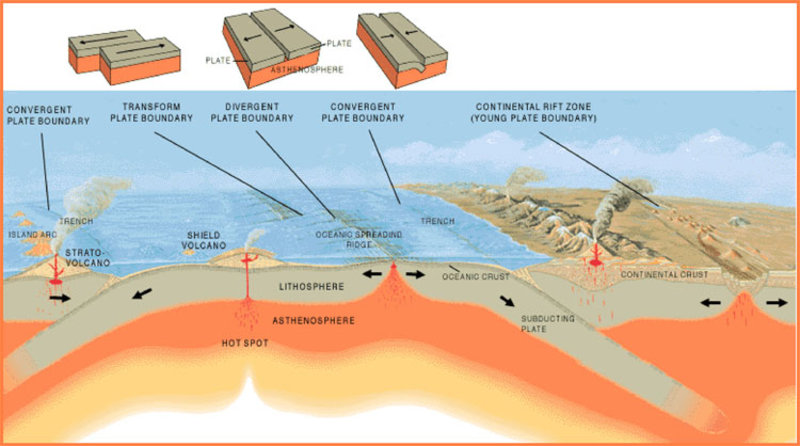
- The plates are constantly in motion but with different speeds and directions, this causes 3 types of plate boundaries, Divergent, convergent and transform.
- A plate boundary or margin is a zone of motion between two plates.
- Diagrammatic representation of different plates:
-
Divergent/constructive plate boundary (6:32 PM)
- The ocean-ocean divergent plate boundary:
- It is a type of plate boundary where two oceanic plate margins are moving apart in opposite directions
- It is a zone of tension where the lithosphere split and hot magma comes up through the cracks and solidifies leading to the formation of a new oceanic crust.
- The continues built of solid magma results in the formation of mid-oceanic ridges along the plate margins.
- In this plate boundary, shallow earthquakes with a focus of up to 70 km are observed.
- The continental-continental divergent plate boundary:
- The formation of divergent plate boundaries along continents involves 3 stages:
- Intra-continental rifting:
- The upward movement of magma below the continental crust causes the fragmentation of the continent through the creation of numerous cracks and faults.
- Such a series of faults is called a rift valley.
- Rising magma starts to come out through this rift.
- For example, the East African rift valley.
- Inter-plate thinning:
- It involves partial melting of the lithosphere and gradual thinning of continental crust.
- Rift valley starts to widen and may gradually get filled with ocean water resulting in the formation of a shallow sea.
- For example, the Red sea.
- Formation of mid-oceanic ridge:
- The continues spreading of continental plates away from each other and the creation of new oceanic crust along the rift valley by the rising magma pulls the continental mass sufficiently apart.
- At this stage, there will be a new oceanic basin along both the sides of mid-oceanic ridge.
- For example mid-Atlantic ridge.
Convergent/destructive plate boundaries (7:42 PM)
- Oceanic-oceanic convergence:
- When two oceanic plate margins converge the ocean plate of higher density decent into the asthenosphere.
- This process is called subduction and the zones are called subduction zones.
- Subduction leads to the formation of trenches, that is the deepest regions on the surface of the earth.
- These subduction zones are the sites of the most widespread and intense earthquakes.
The topic for the next class: Convergent/destructive plate boundaries to continue.